Advanced Higher Physics · Glasgow

Advanced Higher Physics Tutor — Expert SQA Tuition for the Year That Opens University Doors

All three SQA units, the Investigation Project, and the calculus woven through the physics — taught one-to-one by a Glasgow specialist with 15+ years' Advanced Higher experience.

15+
Years teaching AH Physics
3 + 1
Units plus the Project
~30%
Project of total grade
2 ways
Online & in-person
SQA Advanced Higher specialist

The moment it changes is usually the first calculus question. Not calculus alongside the physics — calculus inside the physics, where differentiating a velocity expression is the only way into the problem. Students who arrive at Advanced Higher expecting another year of Higher, done harder, meet that question and understand for the first time that the rules have shifted.

I'm Mohammad Raza, founder of Excel in MathSci, and I have taught Advanced Higher Physics in Glasgow for more than fifteen years. The observation that stays with me across every cohort is this:

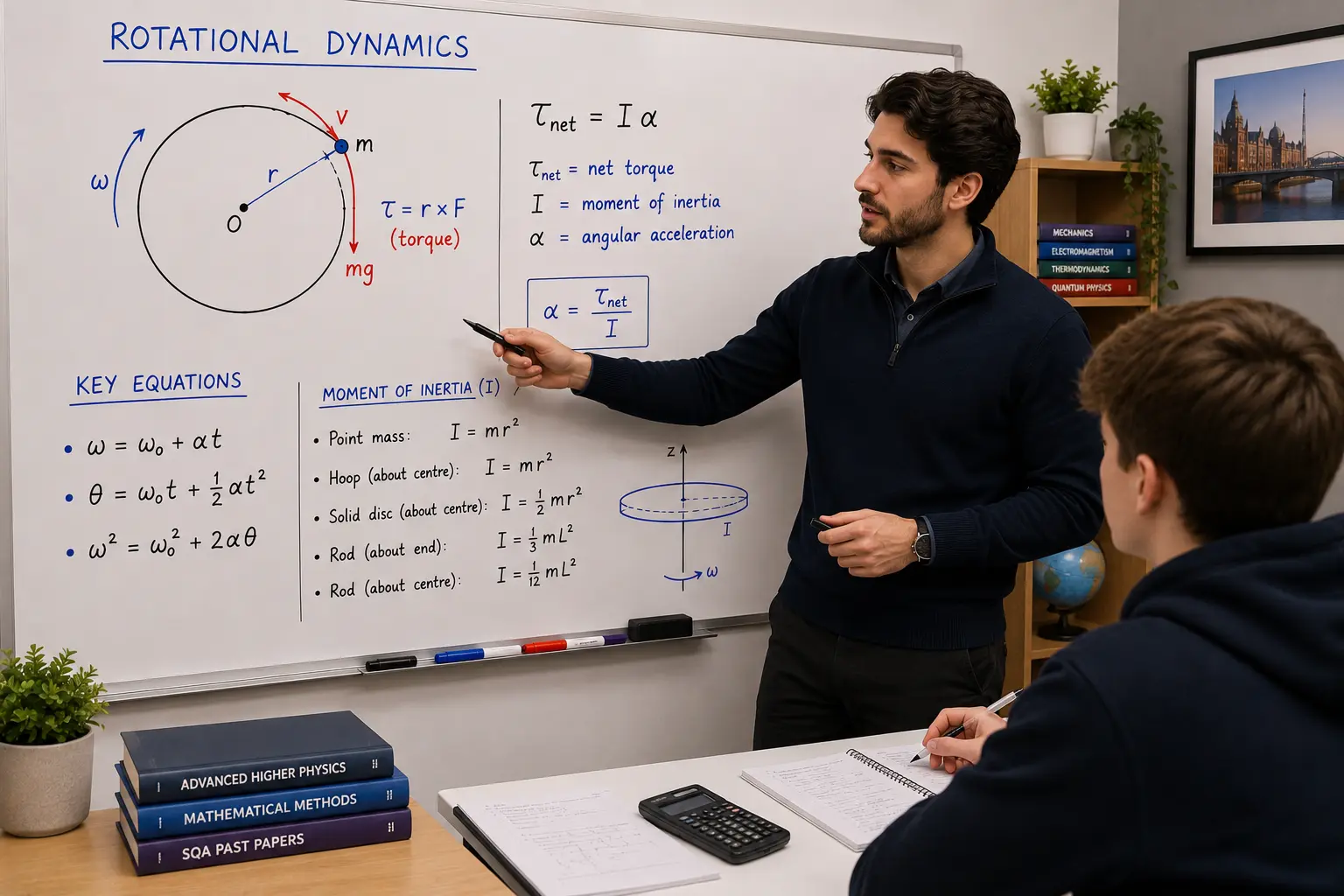
Advanced Higher Physics tutor in Glasgow working through rotational dynamics equations on a whiteboard
The marks Advanced Higher Physics students lose are almost never on the physics itself — they are on the Investigation Project write-up, on uncertainty analysis that was never properly taught, and on the calculus questions they tried to memorise instead of understand. — Mohammad Raza, Founder & Physics Tutor

This page covers all three Advanced Higher units, the Investigation Project in detail, and how calculus features in sessions. As part of our wider service as a physics tutor Glasgow families trust, I cover every SQA level from National 4 through to Advanced Higher. This page is specifically for students whose university ambitions are particular — engineering, physics, medicine, the competitive UCAS courses where Advanced Higher Physics has quietly become the expectation rather than the bonus.

The real step up

Why Advanced Higher Physics is different from Higher — and what that difference costs in marks

Most students arrive at S6 expecting Advanced Higher to be Higher with more complex content. It isn't. The step is qualitative, not just quantitative: calculus moves from occasionally present to woven through the physics itself, questions shift from recall-plus-application to recall-plus-application-plus-derivation, and the Investigation Project introduces assessed work unlike anything at any earlier SQA level. It is the natural step up from Higher Physics, but the strategy that earned an A there does not transfer cleanly.

Advanced Higher Physics involves genuine differential and integral calculus woven through the physics — not bolted on alongside it. The university stakes sharpen everything: engineering at Strathclyde or Glasgow, physics at any Russell Group, competitive medicine at Edinburgh or Aberdeen increasingly use Advanced Higher Physics as a differentiator. An A at Higher used to be sufficient; admissions tutors now see hundreds of those.

Fifteen years of teaching this cohort has confirmed one thing: the students who underperform are almost never weak physicists. They were never shown where the marks on the Investigation report actually sit, or they tried to handle calculus questions by memorising worked solutions rather than understanding the process. The physics is fine. The communication of it, and the mathematical fluency underneath it, are where the grade is quietly decided.

The three units

Advanced Higher Physics units — what we cover and how we teach it

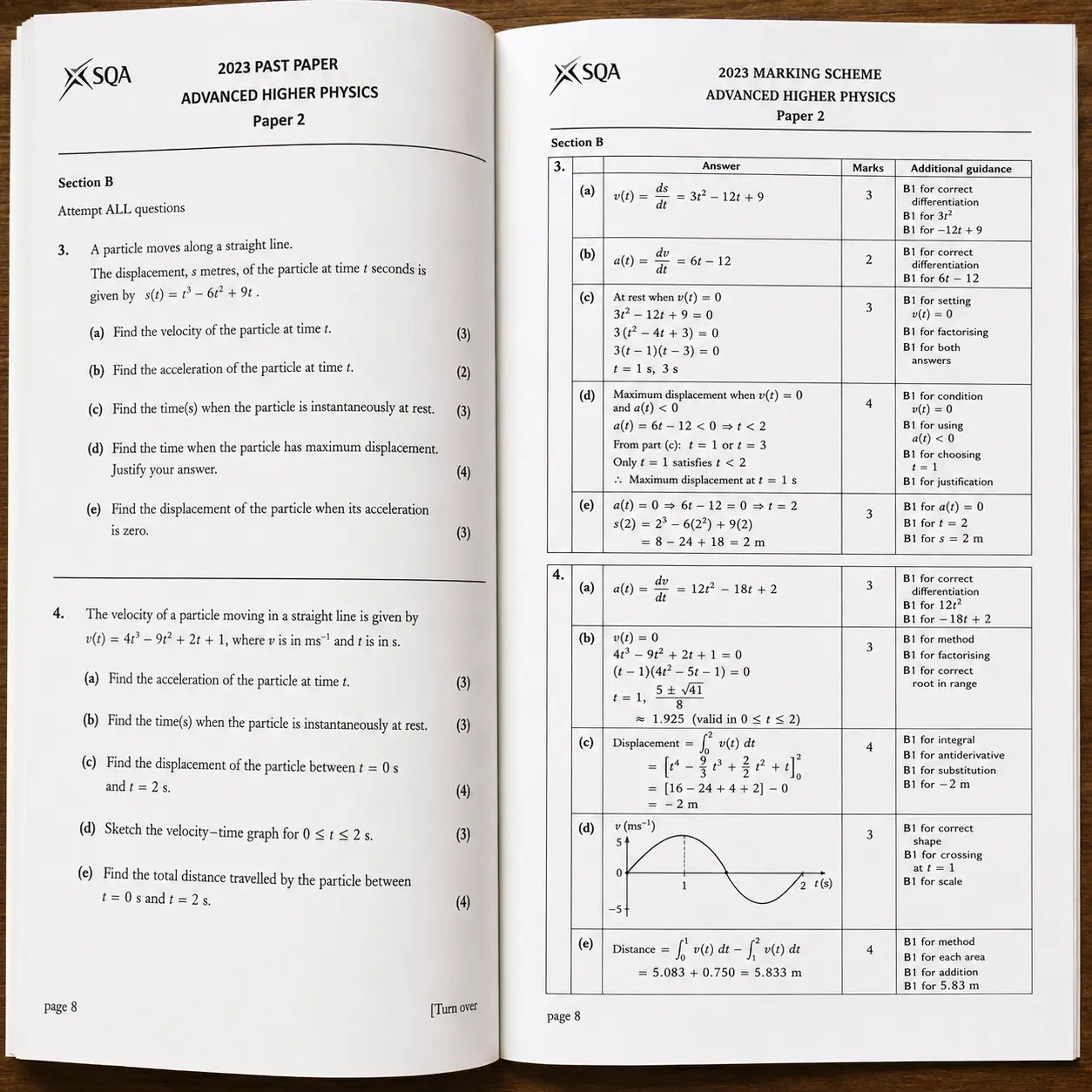
The course is three units plus the Investigation Project, and I teach each through the lens of what the SQA marking scheme actually rewards — not just what the specification lists. Advanced Higher demands genuine mathematical fluency; most schools recommend taking Advanced Higher Mathematics alongside it, and having taught both, I understand why. Reinforce sessions with real SQA physics past papers, marking scheme open.

SQA Advanced Higher Physics past paper open alongside marking scheme showing calculus question

Rotational Motion & Astrophysics

Rotational dynamics (moment of inertia, angular velocity, torque), gravitation at AH depth (Kepler’s laws, gravitational potential, escape velocity) and astrophysics (stellar evolution, H–R diagrams). This is where calculus shows up most aggressively. The named error: treating angular and linear quantities interchangeably — reaching for the rotational analogue of v = u + at without accounting for how moment of inertia changes the motion.
Quanta & Waves

Quantum theory at AH depth — the photoelectric effect with proper mathematical treatment, the de Broglie hypothesis, the uncertainty principle — plus interference, diffraction and polarisation. Worth knowing: de Broglie wavelength calculations are among the most predictable marks in the paper. Taught strictly in sequence — wave model, particle model, the boundary, then uncertainty — it becomes genuinely rewarding rather than facts to memorise.

Electromagnetism

Electric and magnetic fields at depth, capacitors and inductors in DC and AC, RC and RL responses, and the field equations linking electricity and magnetism. The maths is real calculus — capacitor discharge needs genuine integration, not a rearranged formula. The common gap: students grasp the qualitative physics but can’t translate it into the mathematical form SQA rewards. Taught weekly from October, it is manageable by March.

The flagship component

The Investigation Project — where strong students quietly lose the most marks

The Advanced Higher Physics Investigation Project is a self-directed experimental investigation worth approximately 30% of the overall course grade — and it is the most underestimated component of the year. It is assessed on experimental design, data collection, analysis, uncertainty treatment, and the quality of the written report, and it runs alongside the taught units across S6.

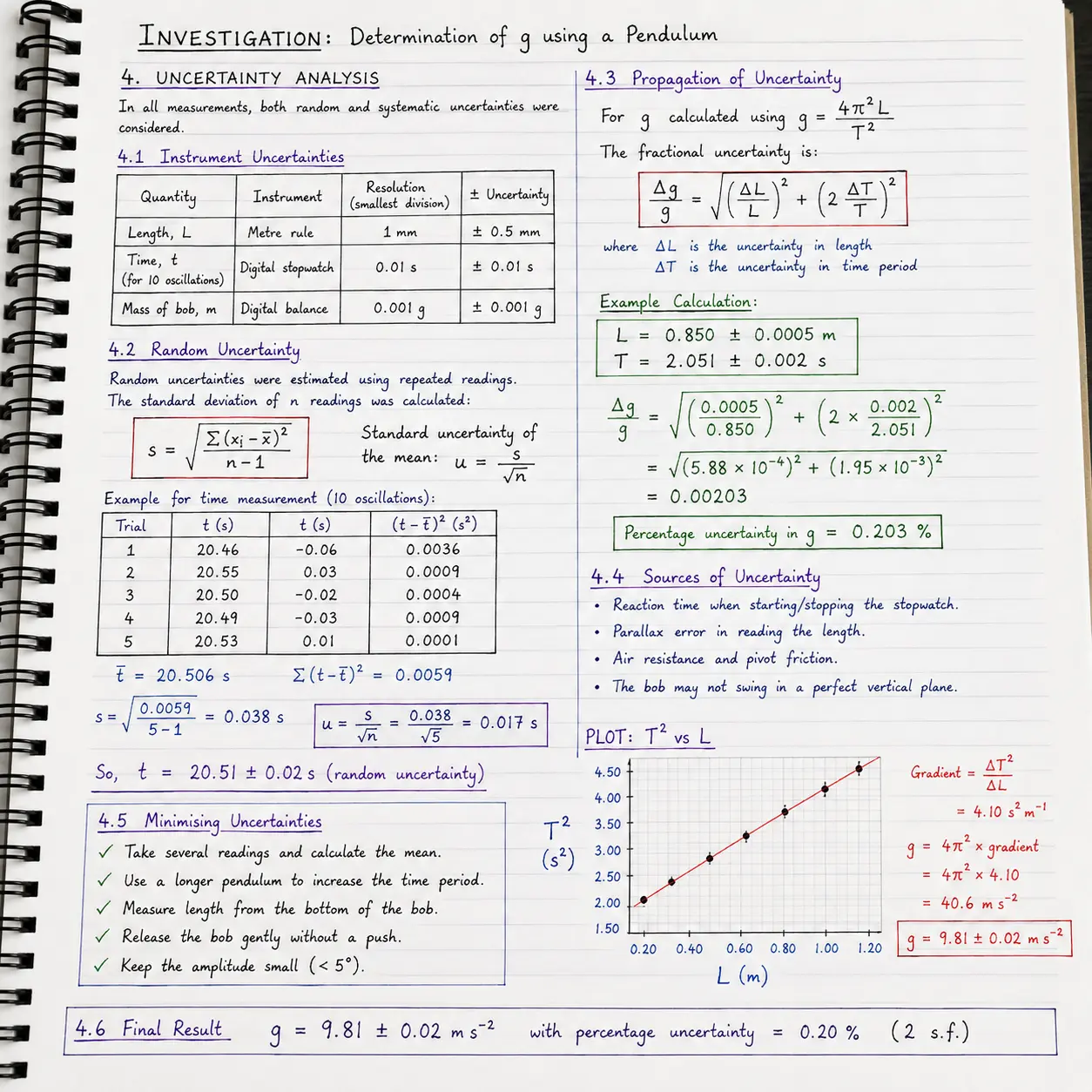
Strong physicists routinely under-perform, and the reason is almost never the science. The experiment works; the data is sound. But the write-up under-explains the method, the uncertainty analysis is a paragraph when it should be a section, and the evaluation reads as a summary rather than a structured discussion. Examiners have a mark scheme for the report. Most students never see it.

Annotated Advanced Higher Physics Investigation Project report showing uncertainty analysis section
01

Choose the topic

Ambitious enough to score well, contained enough to actually finish — not a six-month university-lab project.

02

Design with uncertainty built in

Uncertainty analysis designed into the method from the start, not retrofitted the night before the deadline.

03

Draft in sections

Introduction, method, results, analysis, evaluation — each written to contain exactly what the marking scheme looks for, until it reads like university-lab work.

In person · Glasgow Southside

In-person Advanced Higher Physics tutoring

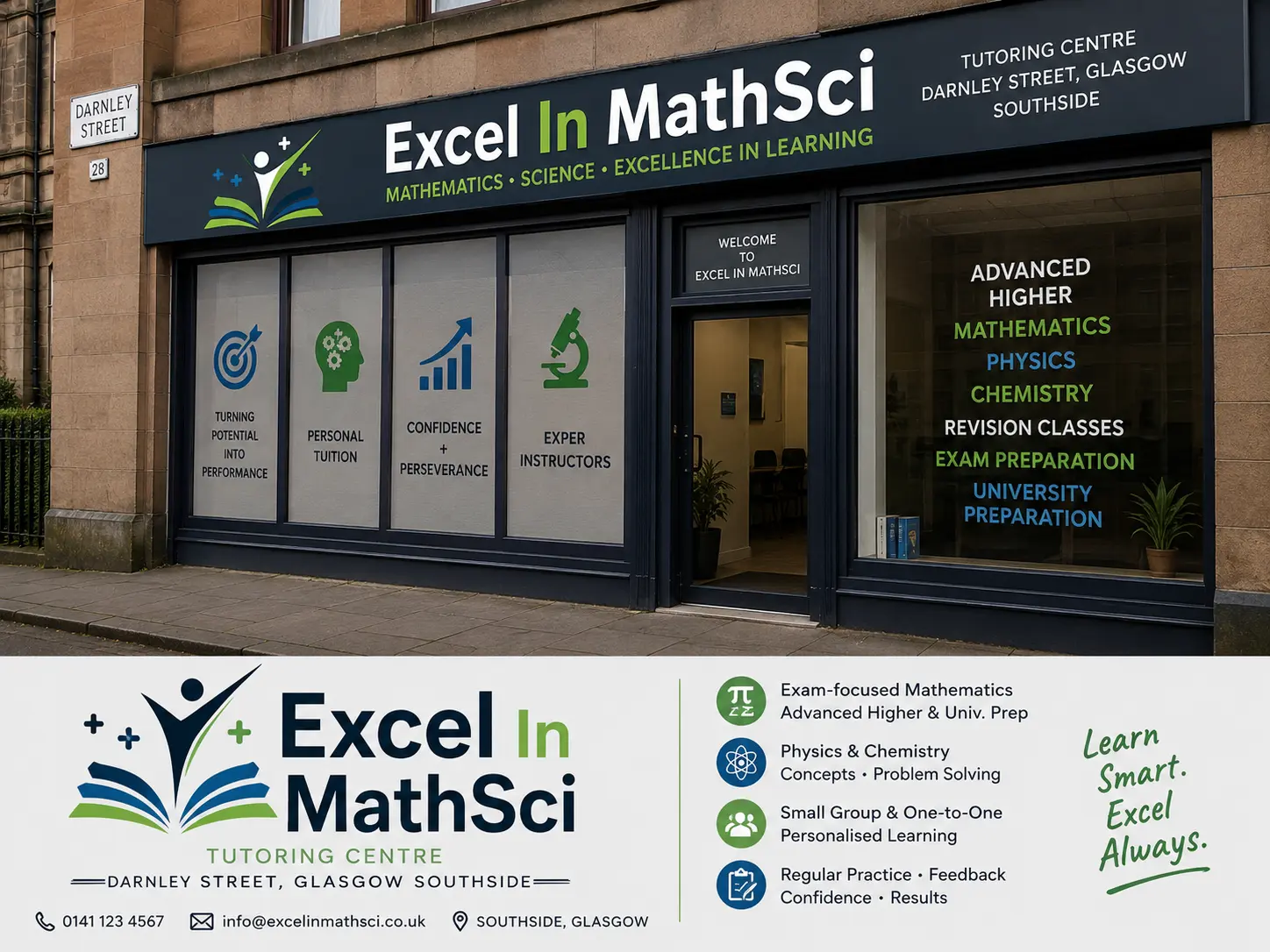
In-person sessions run from our Glasgow Southside centre at Suite 2/14, McCormick House, 50 Darnley Street, G41 2SE. The Advanced Higher catchment skews heavily towards Giffnock and Newton Mearns — families whose children are heading for competitive UCAS courses, whose local schools may cover Advanced Higher Physics with a teacher working outside their primary subject, leaving two hours of class time a week and not much else. Specialist one-to-one input fills a real gap there, not a supplementary one.

Excel In MathSci tutoring centre on Darnley Street Glasgow Southside
Online · all Scotland

Online Advanced Higher Physics tutoring across Scotland

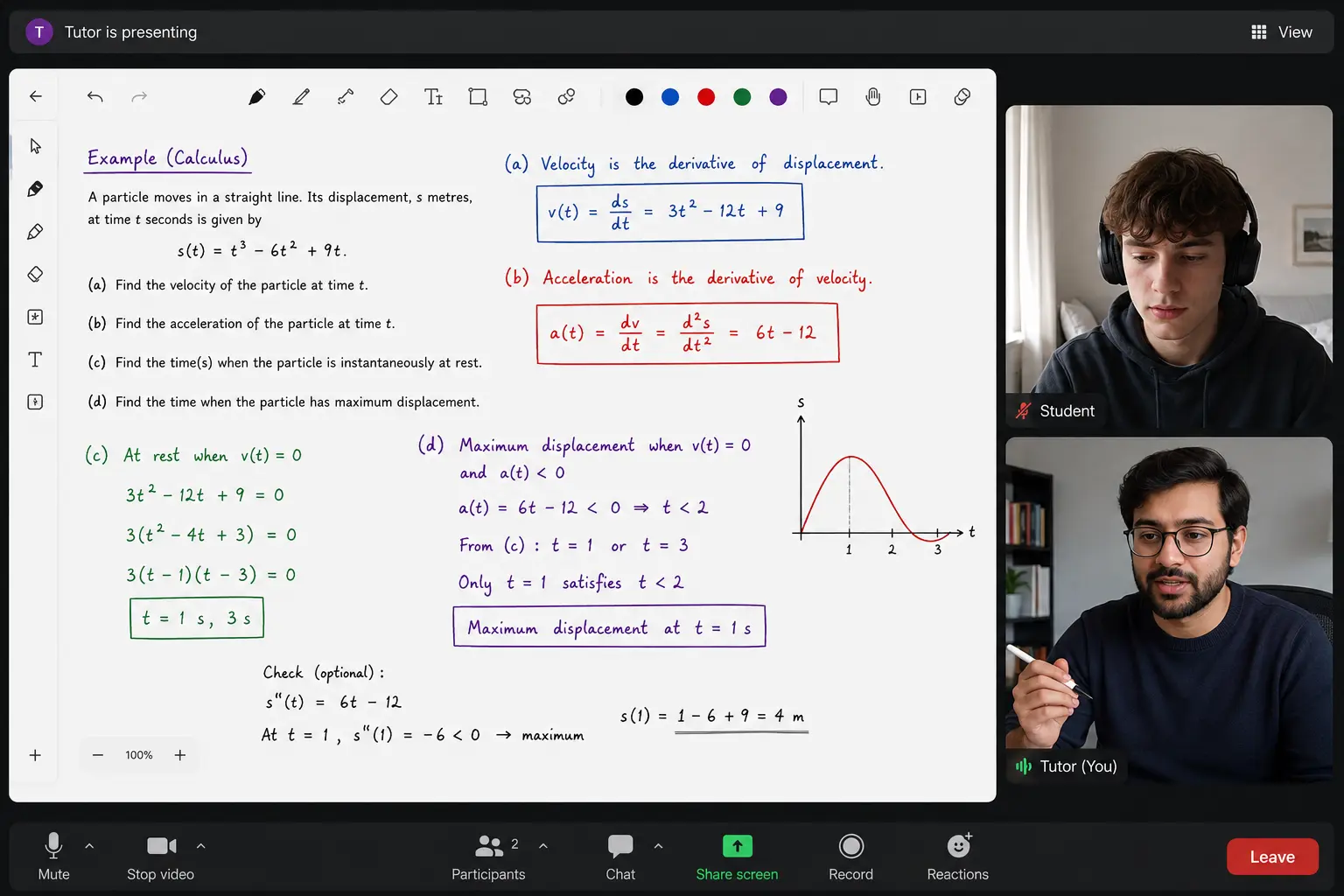
Online sessions run across Scotland — same digital whiteboard, same screen-shared past papers, same calculus working-through, delivered over video call. For S6 students specifically, online often makes more practical sense: UCAS deadlines, university open days, personal-statement revisions and coursework all overlap across the same nine months. If you've looked for an online physics tutor Scotland-wide rather than limited to Glasgow, the SQA curriculum is identical wherever the exam is sat.

Glasgow SouthsideGiffnockNewton MearnsEdinburghAberdeenOnline · all Scotland
Online Advanced Higher Physics tutoring session showing shared digital whiteboard

Frequently asked questions — Advanced Higher Physics tutoring

Is Advanced Higher Physics worth taking?
It depends on where the student is heading. For engineering at Strathclyde or Glasgow, physics at any competitive university, or medicine at institutions that list it as advantageous — yes, and increasingly it's the differentiator rather than the bonus. For students aiming at courses where Advanced Higher Physics is genuinely not required, the workload is substantial and the opportunity cost of not spending that time on another subject is real. I'll give you an honest assessment in the first session rather than a blanket answer.
How hard is Advanced Higher Physics compared to Higher?
Meaningfully harder, and in a specific way. At Higher the exam asks recall plus application plus evaluation. At Advanced Higher it adds derivation — you need to demonstrate mathematical reasoning, not just calculation. Calculus appears throughout, the Investigation Project is a major assessed component unlike anything at Higher, and the question style requires students to show a quality of thinking that Higher does not. Students who get an A at Higher without understanding the underlying physics find Advanced Higher confronting.
What is the Advanced Higher Physics Investigation Project?
The Advanced Higher Physics Investigation Project is a self-directed experimental investigation assessed on experimental design, data collection, uncertainty analysis, and the written report. It accounts for approximately 30% of the overall course grade. Candidates choose a topic, design and carry out the experiment themselves, and submit a written report — typically around 3,000 words — that is marked against a detailed SQA criterion grid. In my experience, it is the most underestimated component of the year.
Do I need Advanced Higher Maths to study Advanced Higher Physics?
Technically no — the SQA does not require AH Maths as a prerequisite. In practice, strongly recommended. Calculus runs through the Electromagnetism and Rotational Motion units in a way that students without calculus experience find significantly harder than the physics itself. I have tutored students who took AH Physics without AH Maths, and the extra session time spent on calculus mechanics is real. If the timetable allows both, take both.
Where do you offer Advanced Higher Physics tutoring?
In-person at Suite 2/14, McCormick House, 50 Darnley Street, Glasgow G41 2SE — well placed for Giffnock, Newton Mearns, and the wider Glasgow Southside. Online across Scotland: Edinburgh, Aberdeen, Stirling, Dundee, and rural areas where a specialist Advanced Higher Physics tutor is not available locally. Many students mix both formats across the year — in-person for Investigation Project sessions, online for the weekly unit work. The full SQA Advanced Higher Physics course specification is available on the SQA website.

Book an Advanced Higher Physics tutor

University on the line?

Book a first diagnostic session

If the university application hinges on Advanced Higher Physics and the year is harder than expected, an early diagnostic session costs nothing beyond the time — and I'll tell you honestly where the gaps actually are. To book directly, call Mohammad on 07577 482130.